
Why do your seals fail?

Seals are small yet critical components in hydraulic and pneumatic equipment. Once they fail, leakage, insufficient pressure or even complete machine shutdown may occur. Downtime can lead to heavy losses. In most cases, seal failure is not caused by poor product quality, but a combination of operating conditions, improper selection, faulty installation or material aging.
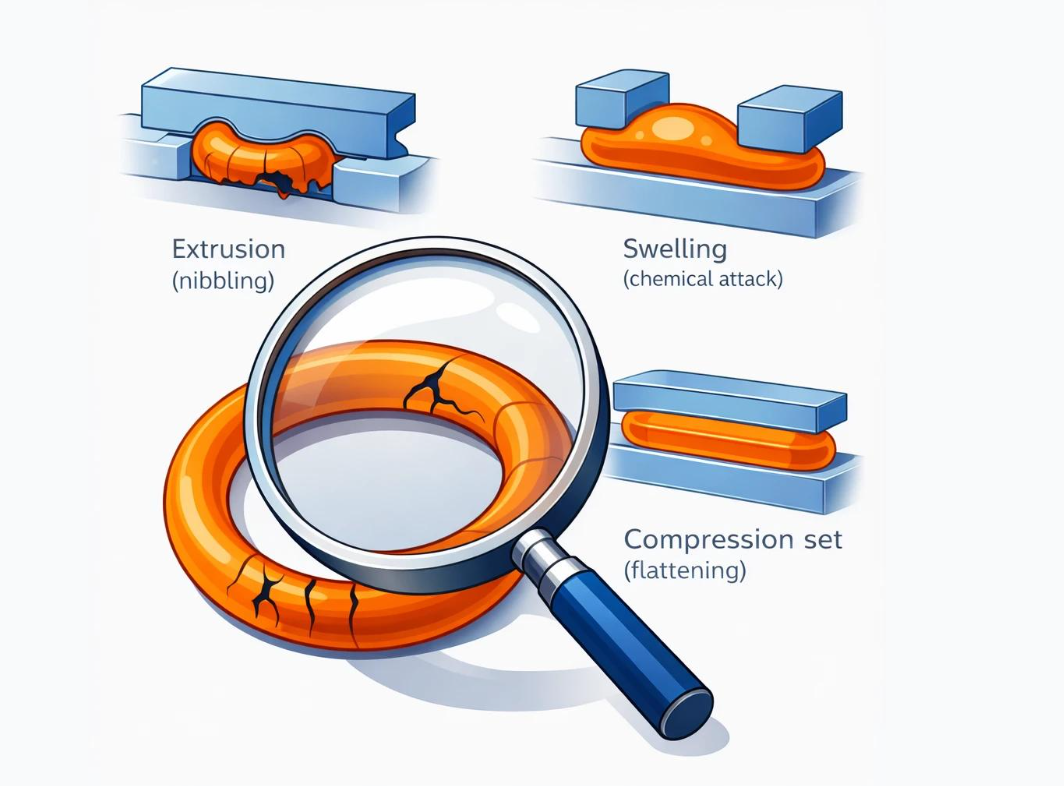
First, improper selection is the most common cause. Seal materials must be compatible with working media. If rubber is not resistant to oil or chemical corrosion, it will swell, harden or crack when exposed to hydraulic oil or coolant. If the temperature exceeds the material’s tolerance range, high temperature accelerates rubber aging and degradation, while low temperature reduces elasticity and compression recovery, so the sealing surface cannot maintain proper contact. Besides, wrong pressure rating or groove dimensions may result in extrusion and nibbling under high pressure, directly damaging the seal.
Second, damage during installation is often overlooked. Sharp edges and thread burrs may scratch the sealing lip during assembly. Tiny scratches are hard to detect at first but will gradually cause leakage during operation. Over-stretching or twisting the seal creates hidden internal damage. If the groove is not cleaned thoroughly, residual iron chips and dust trapped on the sealing surface will continuously abrade the seal and form wear paths.
Third, continuous wear from operating conditions cannot be ignored. Friction from reciprocating or rotary motion accelerates wear without sufficient lubrication. Alternating pressure and impact cause repeated compression and rebound, leading to seal fatigue. Equipment vibration results in intermittent separation of sealing surfaces. With long-term service, the sealing material naturally ages, elasticity drops and compression set increases. Gaps appear on the sealing interface and medium leaks out.
Fourth, defects in groove design and machining. Non-compliant groove dimensions or surface roughness, and excessive or insufficient tolerances will alter the seal’s pre-compression. Without chamfers on groove corners, the seal can be squeezed into the clearance under high pressure and suffer extrusion rupture.
Seal failure rarely happens instantly; it mostly develops gradually from minor damage. Correct material selection, matched working conditions, standardized installation, proper control of medium and temperature, plus regular inspection and replacement can extend seal service life and reduce unexpected downtime losses.
High Quality at Low Cost — DMS Redefines China’s Sealing Industry