
Current Status and Technological Innovation Trends of the Global Rotary Oil Seal Market
- Foreword
In terms of scale and history, the global skeletal oil seal market is dominated by a small number of leading enterprises. These brands boast profound technological accumulation and significant market share in the oil seal sector, while spanning multiple diverse industries and exerting extensive influence in the field of oil seals.
There are also many outstanding local oil seal enterprises in China, which have achieved high capabilities both in terms of scale and product quality. However, these companies often focus on specific niche areas, and few have developed into cross-industry brands—nevertheless, their capabilities have already reached international standards.
- The table below lists the major brands in the global rotary oil seal sector:
|
Brand |
Country |
|
NOK |
Japan |
|
Freudenberg Sealing Technologies |
Germany |
|
SKF |
Sweden |
|
Parker Hannifin |
United States |
|
Trelleborg Sealing Solutions |
Sweden |
III. Directions of Technological Research
As a key power transmission component, technological innovation and improvement of rotary oil seals are directly related to their sealing performance, service life, and applicable working conditions. Currently, the industry’s technological R&D directions mainly focus on the following aspects: innovation in material formulas, improvement of structural design, and enhancement of verification and testing methods.
Directions of Material Innovation
1,High-performance elastomers and rubber modification: Traditional rotary oil seals mostly use elastomeric materials such as nitrile butadiene rubber (NBR) and fluoroelastomer (FKM). In recent years, major manufacturers have been committed to improving rubber formulas to enhance high-temperature resistance, wear resistance, and chemical medium resistance. Examples include sealing materials resistant to carbon dioxide refrigerants (for electric vehicle air conditioning compressors), flame-retardant rubber (to improve safety), insulating and thermally conductive materials (for sealing electrical components), as well as high-damping vibration-damping rubber and saltwater corrosion-resistant materials. These material innovations ensure that oil seals maintain sealing performance under harsher media and environmental conditions.
2,Application of polytetrafluoroethylene (PTFE) and composite materials: PTFE materials are gaining increasing application in the field of rotary sealing due to their excellent temperature resistance, chemical resistance, and low-friction properties. Many manufacturers have launched PTFE lip oil seals, which are used in high-speed and high-temperature scenarios where traditional elastomers are incompetent. The PTFE oil seals of DMS Seals are dimensionally interchangeable with rubber oil seals but can operate under higher linear speeds and poorer lubrication conditions.
In addition, compounding PTFE with rubber is another major direction: examples include PTFE coating technology; mixing PTFE micro-particles or other solid lubricants into the rubber matrix, enabling the oil seal to reduce friction and heat generation while maintaining rubber elasticity.
3,Exploration of other new materials: To adapt to extreme working conditions, some manufacturers are also attempting to introduce materials such as engineering plastics and ceramic coatings. For instance, in high sediment wear environments, the surface of the oil seal lip is coated with a special coating to improve wear resistance; in ultra-high-temperature scenarios (such as aero-engine auxiliary machines), silicone rubber and fluorosilicone rubber are also applied or modified to expand their heat resistance range.
Some research reports propose using filling materials such as silicon carbide and ceramic fibers to enhance the strength and temperature resistance of oil seal skeletons and lips. Although the application of these materials still requires balancing cost and process feasibility, they represent the cutting-edge trends in the R&D of rotary oil seal materials.
Directions for Structural Design Innovation
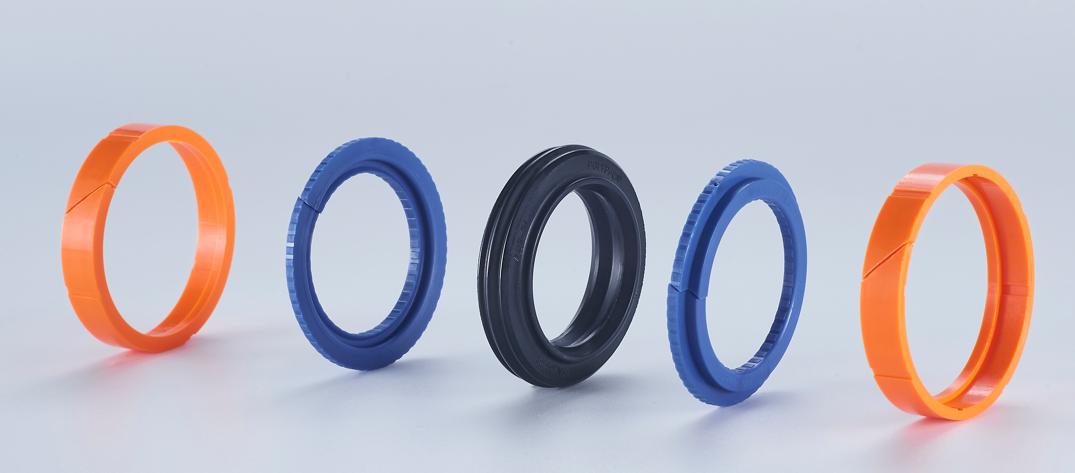
1,Multi-lip Sealing and Dust-proof Structure: In harsh environments such as those with dust, mud, and water, the adoption of a double-lip or multi-lip structure has become a conventional design. The multi-lip structure has also evolved into the cassette seal, which integrates multiple lips and a dust-proof labyrinth into a single component, and is equipped with a built-in grease chamber to ensure sufficient lubrication for each lip.
2,Spring and Spring-less Tensioning Design: Most traditional skeleton oil seals are equipped with a garter spring inside the lip to provide constant radial tension. However, the presence of the spring increases friction torque and carries a certain risk of dislodgement. To address this, manufacturers have made improvements to the spring structure: for instance, using wave springs or annular spring washers instead of coil springs to reduce inertia and wear.
3,Integration of Special Functions and New Sealing Forms: To meet the requirements of modern mechanical equipment for intelligence and high integration, breakthrough innovations have emerged in the structural design of oil seals. A typical example is the sensor-integrated oil seal, which incorporates a magnetic signal generating ring gear and a sensor into the oil seal skeleton. This design enables the seal to output rotational speed/position signals while sealing the rotating shaft.
IV. Future Outlook
Based on the current technological evolution and market dynamics, the rotating oil seal industry is facing a crucial opportunity for transformation and upgrading. Looking ahead, the following trends and potential layout changes deserve attention:
Technological Changes Driven by New Energy Vehicles (NEVs)
The electrification of the automotive industry is an irreversible trend, which presents new requirements and opportunities for rotating oil seals.
On one hand, although NEVs eliminate traditional internal combustion engines, they still require oil seals for components such as motor bearings and reduction gearboxes. Motor speeds are often much higher than those of internal combustion engines (reaching 10,000–20,000 revolutions per minute) and may involve high-speed bidirectional rotation. This demands oil seals with higher linear speed resistance and bidirectional sealing performance.
On the other hand, NEVs reduce the number of oil seals used for components like engine crankshafts and camshafts, which impacts the business volume of traditional oil seals. However, NEVs also create new demands for seals such as battery cooling pump shaft seals and electric compressor shaft seals—with even higher requirements for sealing reliability (as NEVs generally pursue maintenance-free operation). Consequently, oil seal enterprises are adjusting their product lines and developing comprehensive sealing solutions for NEVs. It is foreseeable that the first enterprise to provide verified and reliable NEV-specific oil seals will gain an advantage in the future automotive market. In summary, high speed, low friction, and wide temperature range will be the key technical keywords for oil seals in the new energy era.
Localization of High-end Products and Reshaping of Market Pattern
For a long time, the high-end rotating oil seal market has been dominated by European, American, and Japanese giants, with many OEMs (original equipment manufacturers) in developing countries highly dependent on imported oil seals. However, this situation is gradually changing.
In the next few years, with the improvement of regional supply chains, the global oil seal supply landscape may shift from the traditional center of Europe, America, and Japan to regions such as Asia-Pacific. It is expected that local enterprises will continue to increase their market share in their home countries, while international brands will compete more through technology and brand strength rather than relying solely on import channels.
Intelligent Manufacturing and Product Intelligence
The "Industry 4.0" wave is also influencing the oil seal industry. On one hand, factory manufacturing processes are becoming increasingly intelligent—automated production lines are widely adopted in all links, from rubber mixing and compression molding to quality inspection and packaging. This enhances product consistency and cost control.
V. Conclusion
Although the rotating oil seal industry belongs to the traditional manufacturing sector, it is undergoing profound changes driven by new technologies and new demands. Advances in materials science, innovations in design concepts, and the reshaping of market forces are driving oil seal products toward higher performance, longer service life, and greater reliability.
Maintenance Methods for Mechanical Seals Under Severe Operating Conditions
Difference Between KDAS and DPM in Hydraulic Five-Combination Seals